

The Antiquarian at Greenwich
Chinese Han Dynasty Patinated Bronze Archastic Vessel
$10,500.00
Call For Location | 203-325-8070
The Antiquarian at Greenwich
Chinese Han Dynasty Patinated Bronze Archastic Vessel
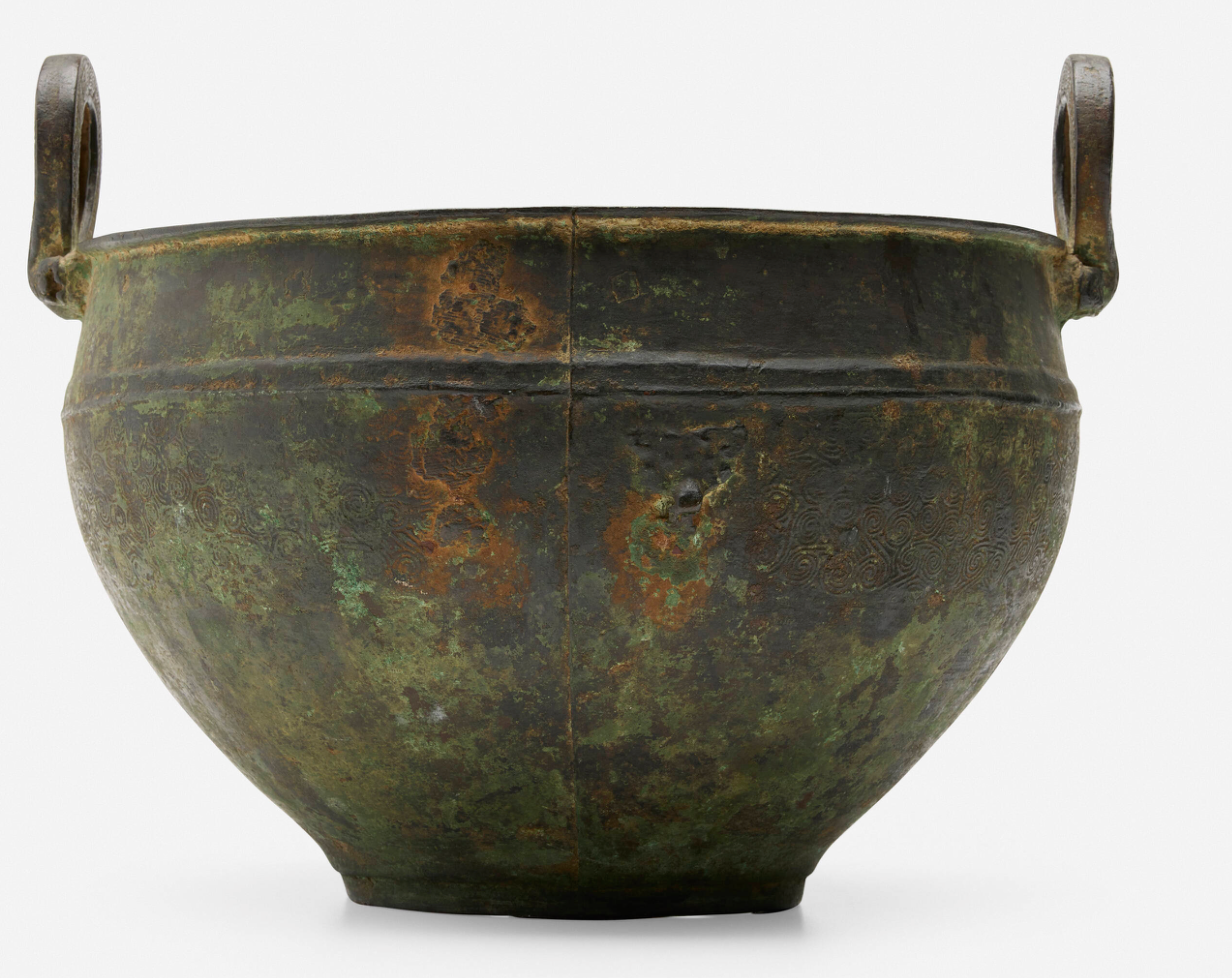
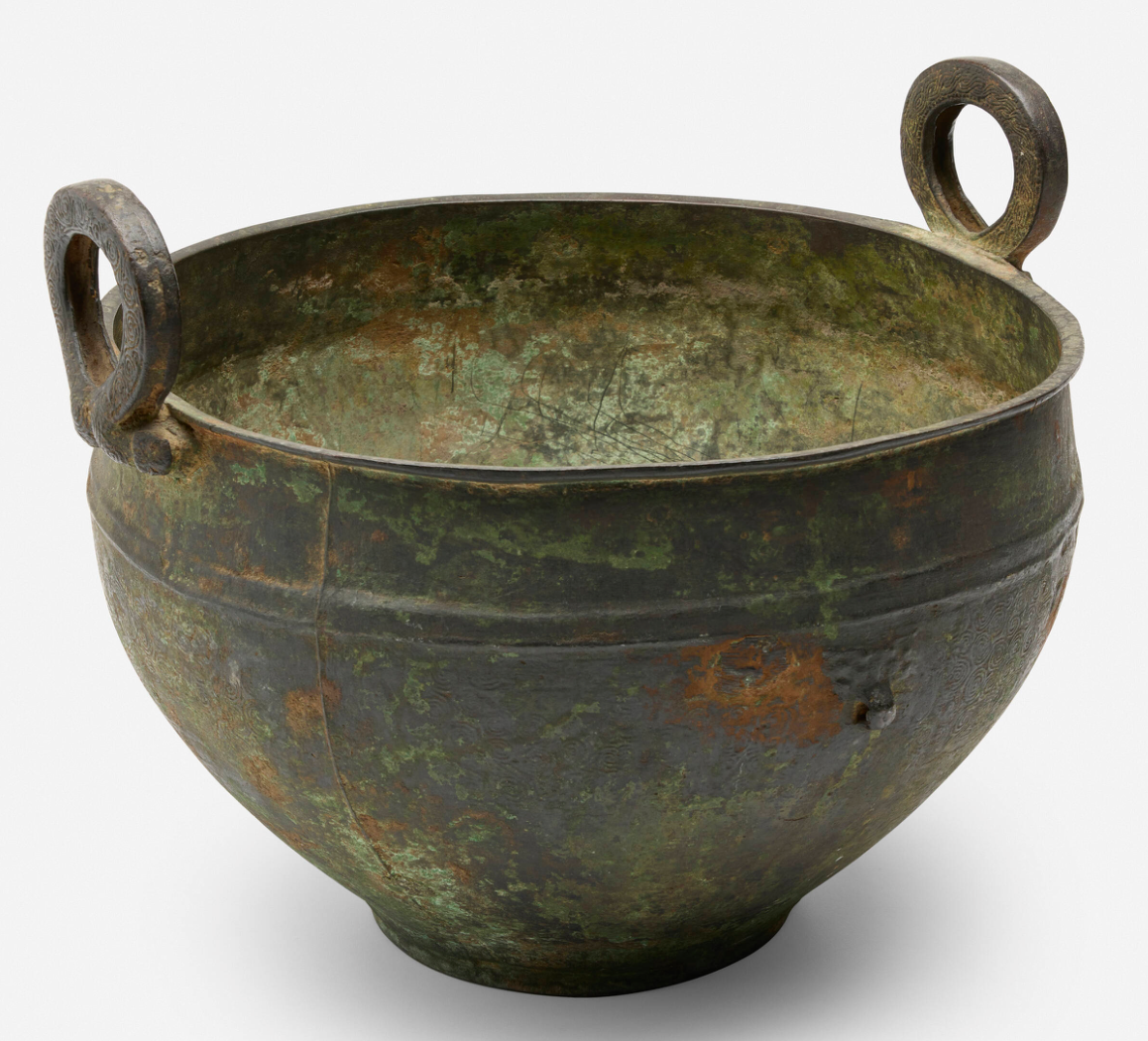
A Chinese Archaic Bronze Steamer (Zèng 甑) Han Dynasty, probably Western Han (206 BCE – 9 CE) to Eastern Han (25 – 220 CE) Patinated cast bronze Dimensions: H: 12 in. x W: 15 in. x D: 14 in.
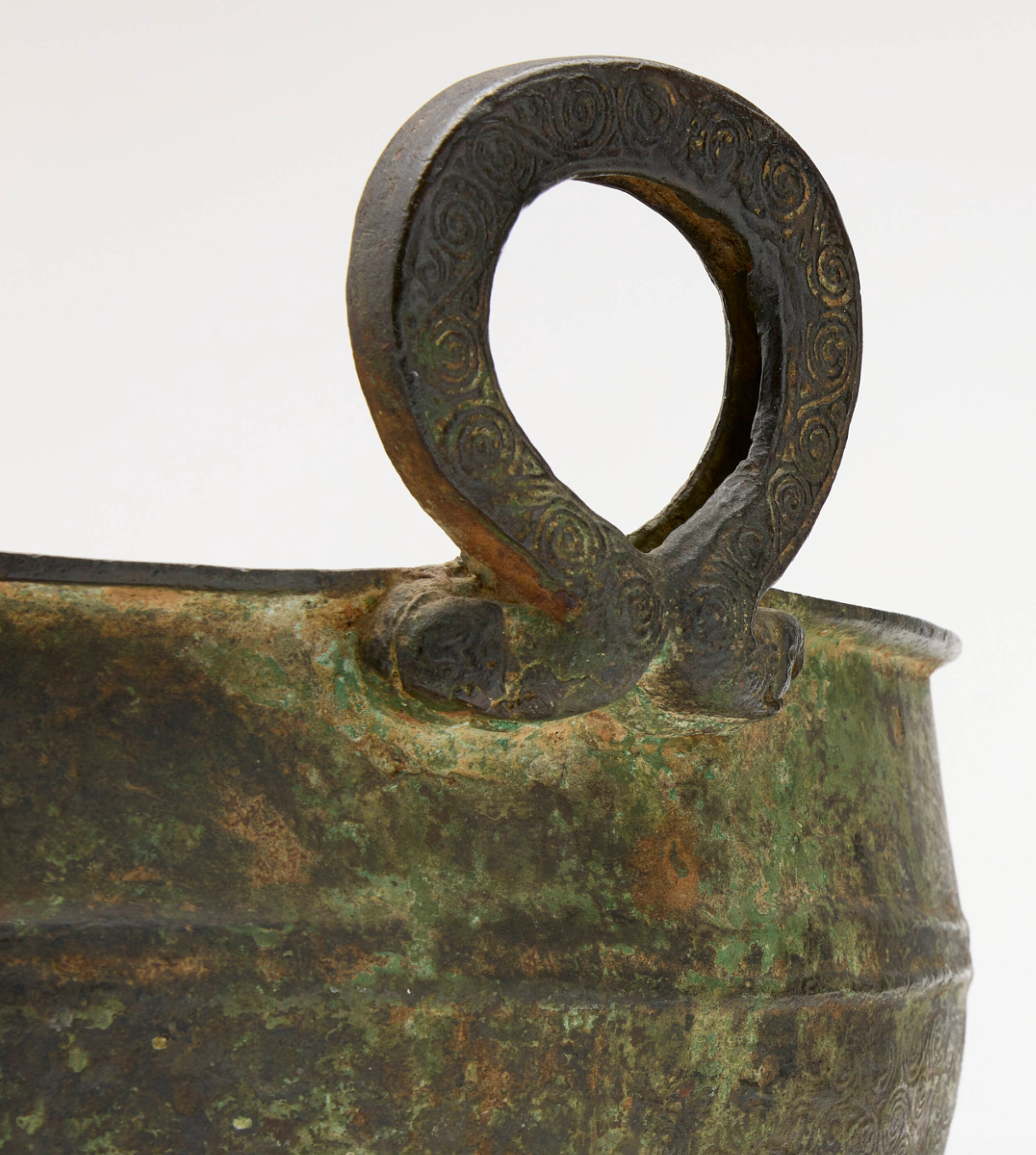
A wide-mouthed deep bronze bowl on a narrow ring foot, the body rising in two horizontal registers separated by a cast cordon. The upper register, below a plain rim, carries a frieze of densely interlocking cast spirals — the yún wén (云纹), or cloud pattern. Two large loop handles rise vertically from the shoulders, set into small cast lugs and decorated on their outer face with the same spiral motif carried in low relief around the full circumference of each loop. The base, viewed from beneath, is pierced with radial wedge-shaped slots arranged around a small central boss — the working strainer floor of a steamer. A vertical mold seam runs the height of the body, the trace of piece-mold casting. The surface carries a layered patina of malachite green, cuprite red, and earth-brown encrustation consistent with prolonged burial.
On the form
The pierced floor is the key. This is not an ornamental vessel but the upper component of a working two-part steamer, called a zèng (甑) in Chinese. In the full assembly — known as a yǎn (甗) — the zèng sat above a tripod cauldron (lì 鬲 or dǐng 鼎) of boiling water, with the perforated grate between them allowing steam to rise into the upper chamber and cook food. The Yan steamer originated in Neolithic pottery and was cast in bronze from the Shang dynasty onward, remaining in use through the Han. Bronze examples were aristocratic — the form is a status marker in the highly stratified Shang and Zhou societies, and continued as a tomb-furnishing object well into the Han, when it appears in elite burial inventories alongside cooking vessels for the afterlife.
The two-part yǎn was the standard form in the Shang and early Western Zhou; from the late Western Zhou onward, separate zèng and lì components — combined as needed — became more common. Your vessel is the zèng component alone. The wide loop handles, narrow foot ring, and integrally cast pierced floor are all consistent with Han-period production.
On the motif
The dense spirals on the shoulder frieze and the handle loops are the yún wén (云纹), the "cloud pattern" — sometimes called yún qì wén (云气文), "cloud-vapor pattern." It is distinct from the related Shang-Zhou léi wén (雷纹), or "thunder pattern," which uses squared right-angled spirals as a ground filler beneath taotie masks; the yún wén is its later, looser, curvilinear descendant. The pattern emerged in the Warring States period and became one of the defining decorative themes of Han bronze, lacquer, mirror, and stone-relief surfaces.
The meaning, in the Han context, was specific. Clouds were the matter of the immortal realms — the cloud-shrouded peaks of Mount Kunlun in the west and Mount Penglai in the eastern sea, where the xian (仙, immortals) were believed to dwell. They were also a visual form for qì (气) itself — the vital energy or "cloud-breath" that animated all living things and that, after death, the hún (魂) soul would travel through on its journey to the celestial realms. Under Emperor Wu (r. 141–87 BCE), the Han court's interest in Taoist immortality cults and the celestial journey reached its apex, and the cloud-scroll became the dominant decorative idiom of funerary and ceremonial objects of the period. To bury a Han nobleman with a bronze steamer decorated in clouds was both practical — provisioning him with cooking equipment for the afterlife — and cosmological, surrounding his food vessels with the matter of the realms his soul was preparing to enter.
Comparable examples
The Metropolitan Museum of Art, New York. Part of a steamer (Zeng), China, Western Zhou dynasty (1046–771 BCE), accession 61182. H. 9¼ in., W. at handles 13⅝ in., diameter of rim 12¼ in. The standard institutional comparable for the form, though approximately a millennium earlier than your example. Same component (upper steamer), same loop-handle attachment, same general silhouette.
Tomb of Dou Wan, Mancheng, Hebei. Wife of Liu Sheng, Prince of Zhongshan, Western Han, d. c. 113 BCE. The tomb yielded two bronze yǎn steamers (catalogued as Bronze yan A and Bronze yan B from the tomb of Dou Wan, Wikimedia Commons). These are the closest dated archaeological comparables for the form in a Western Han elite burial context.
Museum of the Mausoleum of the Nanyue King, Guangzhou. Tomb of Zhao Mo, King of Nanyue, ruled 137–122 BCE. The tomb yielded more than fifty cooking implements in gold, silver, and bronze, including steamer components — a major documented Western Han assemblage of the vessel category.
Freer Gallery of Art, Smithsonian (F1968.33). Han dynasty (206 BCE – 220 CE) bronze bowl with everted lip, low foot ring, and two movable ring handles suspended from looped relief masks below the rim, with a frieze of "swirling, abstract decoration" below the rim. A different vessel function (not a steamer) but the closest direct comparable for the cast cloud-scroll frieze on the shoulder paired with applied handles. Provenance: C. T. Loo to Eugene and Agnes Meyer, gift to the Freer 1968.
Princeton University Art Museum (y1986-111 a-b). Western Han earthenware hu storage jar with painted bands of cloud scrolls. Not a direct formal comparable, but the cleanest single source for the cloud-scroll meaning, with curatorial text noting that the patterns "borrow their forms from the bodies of interlaced dragons in earlier Eastern Zhou ornament."
Aberdeen City Council Museums, Scotland (ABDMS014544). Bronze "yen" steamer, James Cromar Watt Bequest 1941. 32.1 × 22.2 cm. Date listed as unknown, with the museum's note that "Chinese bronzes made in later dynasties copied the shape of the yen steamer" — a useful caveat on the dating problem for this category.
On the dating and the attribution
Han Dynasty (c. 200 AD) or later is conservative and the or later hedge is appropriate, since the form was sometimes reproduced in archaistic productions of the Song and later. Three things argue for an authentic Han date:
- Patina. The layered malachite/cuprite/earth-encrustation surface visible on the auction images is consistent with prolonged burial rather than chemical aging; archaistic reproductions typically lack the cuprite-red cores beneath the green patination that develop only with millennia in contact with soil moisture.
- Casting. The visible vertical mold seam is characteristic of piece-mold casting, the standard Chinese bronze-casting technique used from the Shang through the Han. Later archaistic reproductions, particularly post-Tang, are more commonly lost-wax cast and show no mold seam, or use a different seam geometry.
- Motif. The dense cast cloud-scroll on the shoulder and handles is a Han-period decorative idiom, not a Tang or Song revival vocabulary. Later archaistic bronzes more often reproduce Shang-style taotie masks and leiwen grounds than Han-style cloud scrolls.
Reference works for further research
- Jessica Rawson, Western Zhou Ritual Bronzes from the Arthur M. Sackler Collections (1990). Standard reference for the form-typology and motif-vocabulary of the predecessor period.
- Robert Bagley, Shang Ritual Bronzes in the Arthur M. Sackler Collections (1987). Foundational for the casting techniques carried forward into the Han.
- Wu Hung, Monumentality in Early Chinese Art and Architecture (1995). Strong on the cosmological and funerary symbolism of cloud-scroll decoration.
- Loehr, Max, Ritual Vessels of Bronze Age China (1968). Older but still standard for the form classifications.
- The Metropolitan Museum's collection database under "zeng" and "yan" returns approximately twenty pieces; the comparable browsing there is more useful than at any single secondary reference.


