

The Antiquarian at Greenwich
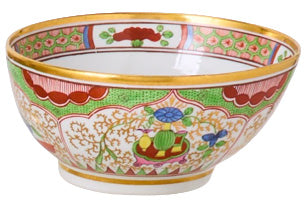
A Worcester Porcelain Bowl in the Dragons and Compartments Pattern
$1,200.00
Call For Location | 203-325-8070
The Antiquarian at Greenwich
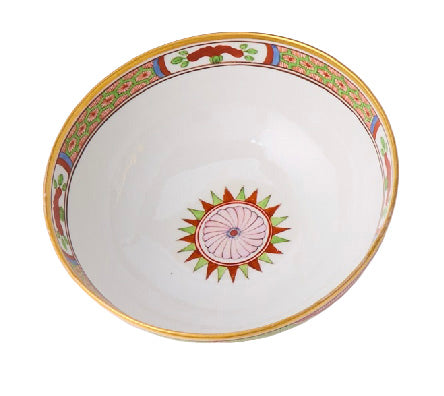
A Worcester Porcelain Bowl in the Dragons and Compartments Pattern
Circa: 1793-1810A Concise History of Worcester "Dragons in Compartments"
Origins in the Chinese Taste
The "Dragons in Compartments" pattern emerged from 18th-century Europe's passion for East Asian porcelain. British potters at Worcester created it as an interpretation of Chinese famille-verte export wares, specifically imitating the Japanese Kakiemon style that had become highly fashionable among wealthy European households. Collectors today sometimes encounter the pattern under alternative names, including "Bengal Tiger," "Kylin," or "Kylin in Compartments," reflecting the stylized beasts at the heart of the design.
The Meaning Behind the Kylin
The kylin (from the Chinese qilin, or Japanese kirin) is a mythical creature found throughout East Asian cultures, typically depicted as a dragon-like ox or horse with antlers and a long tail. Unlike Western monsters, which bring terror and disaster, the qilin symbolizes luck, protection, prosperity, success, and longevity. Sighting one was considered a good omen and a sign of fertility, which is precisely why diners prized tablewares decorated with these creatures: eating breakfast from a qilin dish was thought to bring a new baby into the family. The creature captured imaginations so thoroughly that when Chinese explorers first encountered giraffes in 15th-century Africa, they believed they had found living qilins and brought specimens back to the Emperor, who kept them in his gardens for centuries in the belief that their presence would bring good fortune to the Empire.
Pattern Characteristics
The design divides into four or more shaped panels, or "compartments," each framing stylized dragons, kylins, and floral vases arranged around a central floral motif. Its palette is immediately recognizable: vibrant iron red, deep cobalt blue, and green, all heavily heightened with gilding.
Historical Periods and Manufacturers
The original Worcester factory introduced the pattern in the 1770s, and variations have been produced by all three successive Worcester factories since, remaining popular across different ownerships for well over a century.
The earliest examples date to the First Period, or "Dr. Wall" period, circa 1765–1783, when the pattern was hand-painted on soft-paste porcelain. Pieces from this period often bear a square "blue chop" or seal mark on the underside.
The pattern was then produced extensively by Chamberlain's Worcester in the late 18th and early 19th centuries. Robert Chamberlain, who had originally worked as a decorator for the main factory, opened his own manufactory in 1793 and produced high-quality versions of the design. Chamberlain pieces are often marked with "Chamberlain's Worcester" in iron-red script.
Production continued into the early 19th century under Flight, Barr & Barr, whose version saw further refinement of the pattern. Their pieces are often found on fluted forms and typically carry impressed "FBB" marks.
Significance and Value
In its own time, hand-painted porcelain of this quality was a serious luxury reserved for wealthy households. Complete services are now extremely rare, which has made individual surviving pieces highly desirable among collectors. At the top of the market, a Chamberlain Worcester part dessert service circa 1800 sold at Christie's in 2019 for USD 35,000, a figure that reflects both the rarity of intact examples and the technical skill the pattern demanded from its painters and gilders.
Dimensions: H: 4
6 1/4


