

Nicholas Savard
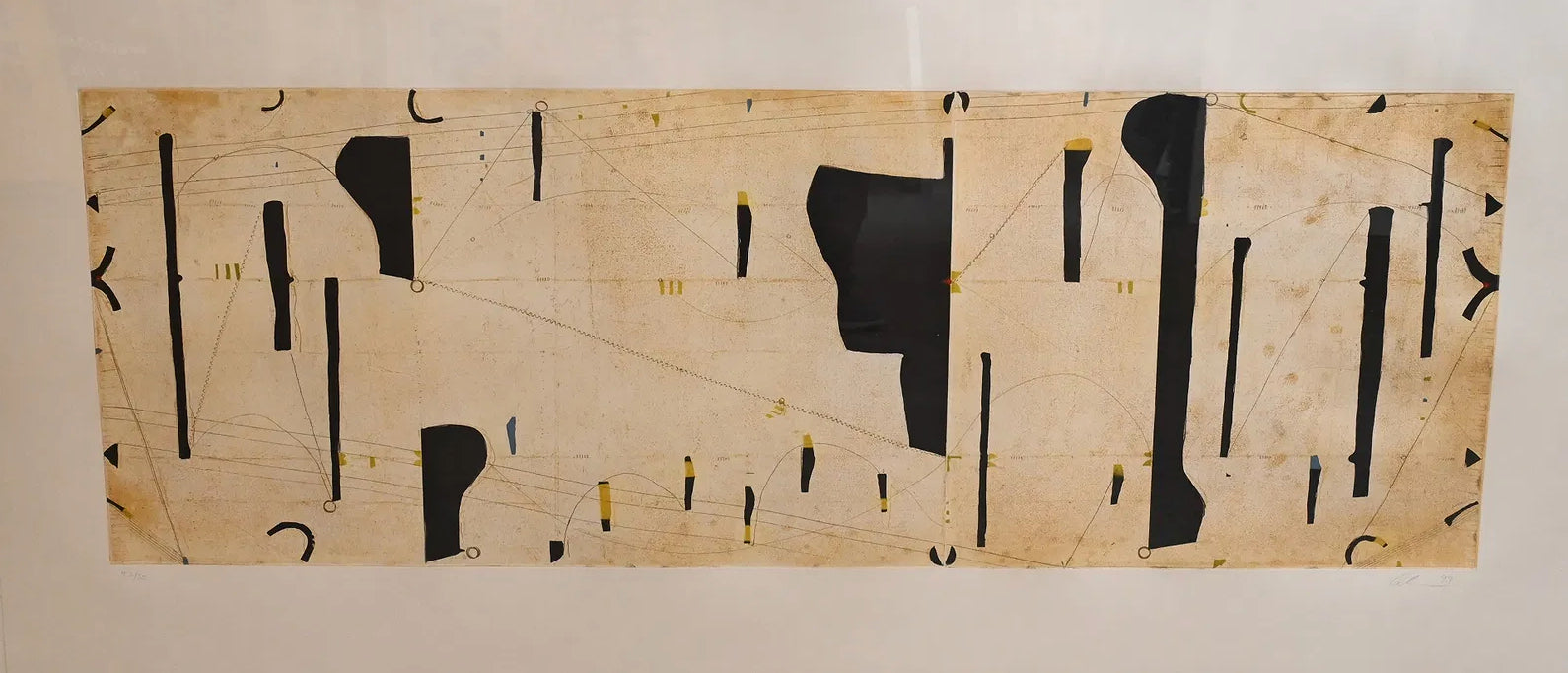
Etching with Aquatint "Untitled Invention" by Caio Fonseca (American b.1959)
$14,900.00
Call For Location | 203-325-8070
Nicholas Savard
Etching with Aquatint "Untitled Invention" by Caio Fonseca (American b.1959)
|
ARTIST |
Caio Fonseca, American, b. 1959 |
|
TITLE |
Untitled Invention |
|
DATE |
1999 |
|
MEDIUM |
Etching with aquatint |
|
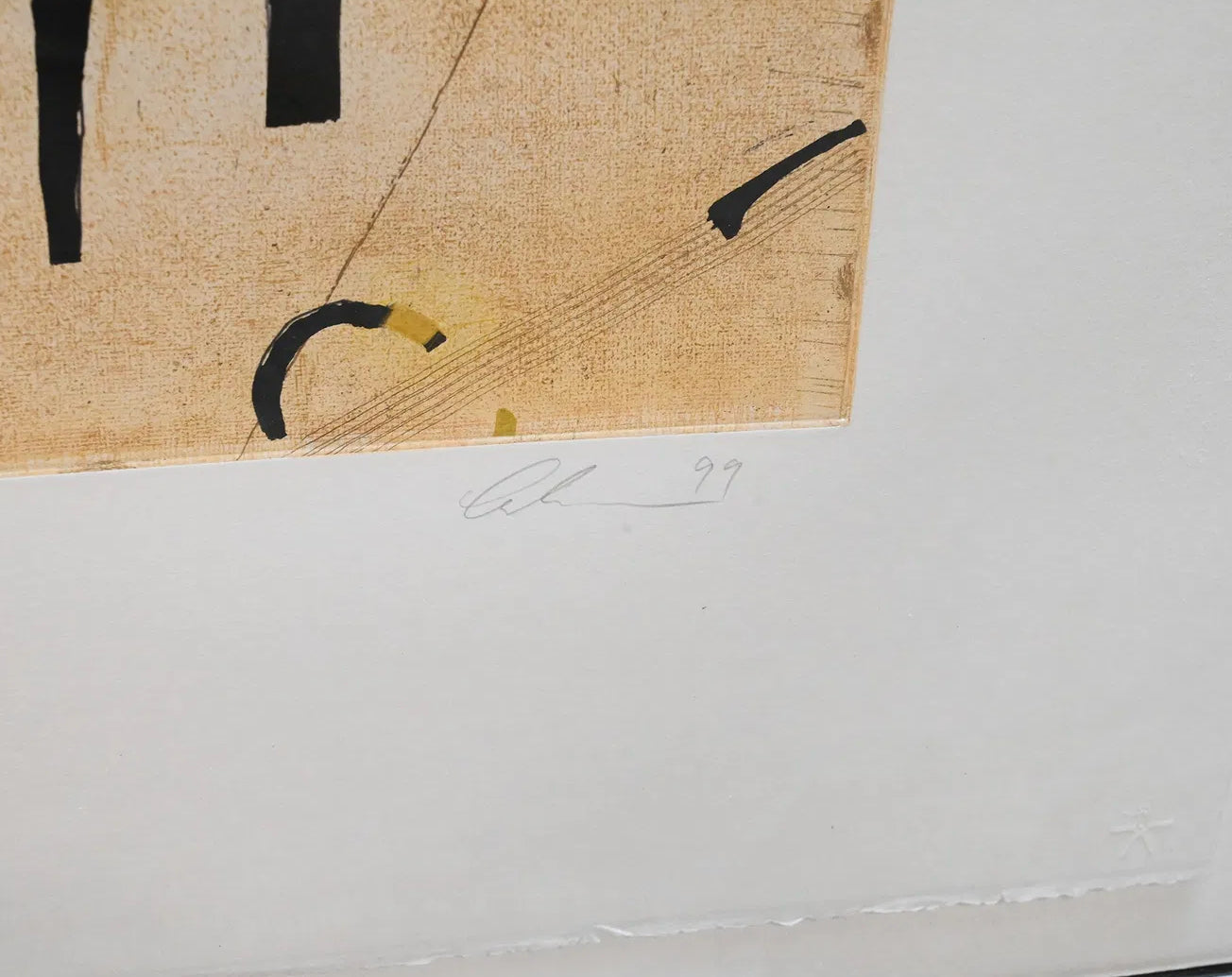
SIGNATURE |
Pencil signed and dated, lower right |
|
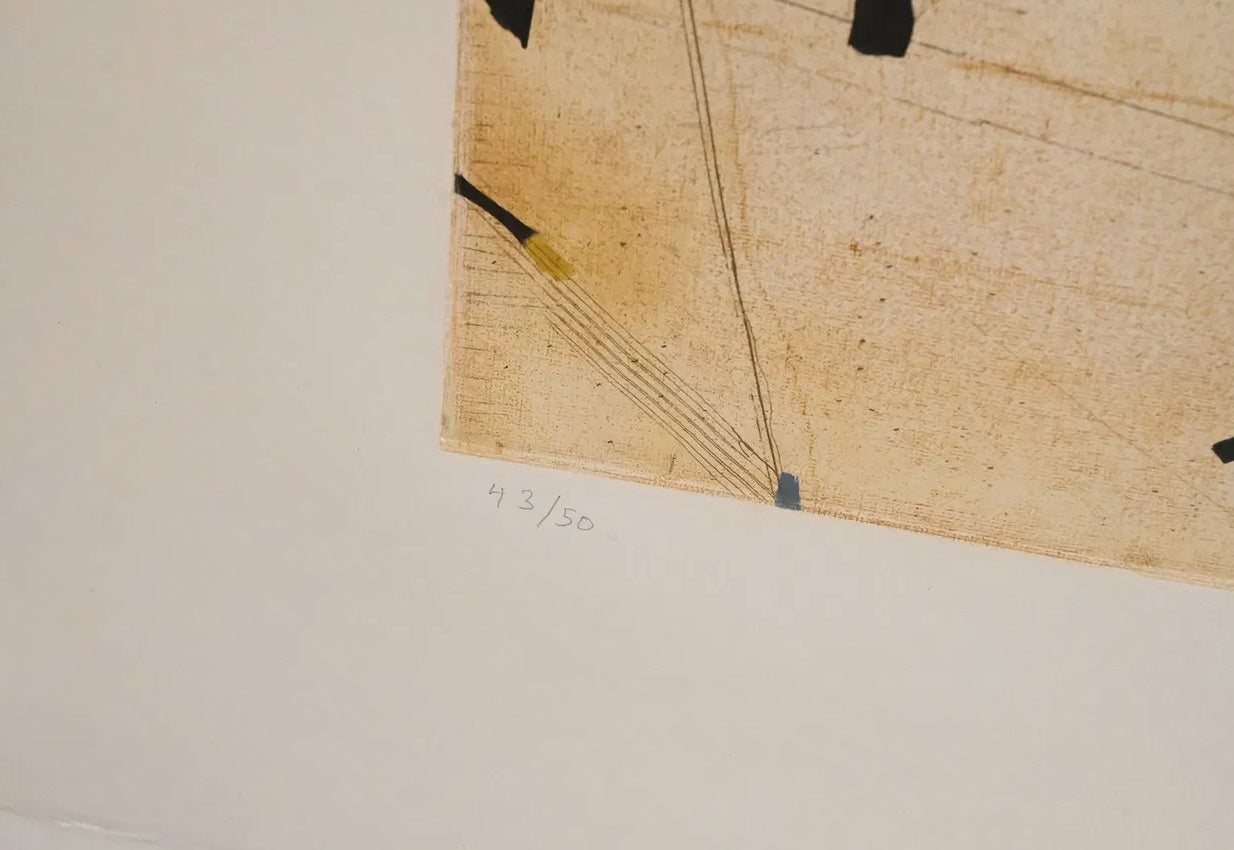
EDITION |
43/50, lower left |
|
DIMENSIONS |
29" x 63" |
|
PROVENANCE |
Stroock & Stroock & Lavan |
A striking, large-format work from Caio Fonseca's celebrated print production, "Untitled Invention" pairs the artist's signature abstract vocabulary with the rich tonal depth of etching and aquatint. Bold, glyph-like black forms — some architectural, some almost calligraphic — punctuate a warm, weathered cream ground crossed by faint compass lines, arcs, and geometric notations that recall a draftsman's working sheet. The panoramic 29" x 63" format allows Fonseca's rhythmic, music-inspired compositional language full room to breathe, with forms reading almost like notation across a musical staff. Pencil signed and dated by the artist lower right and numbered 43 from an edition of 50 lower left, this 1999 etching carries notable provenance from the collection of Stroock & Stroock & Lavan, the venerable New York law firm long associated with a significant collection of contemporary art.
About the Artist
About the Artist
Caio Fonseca (b. 1959, New York) is an American abstract painter and printmaker celebrated for his lyrical, tonally sophisticated compositions rooted in the language of classical music. The son of Uruguayan modernist sculptor Gonzalo Fonseca and brother of painter Bruno Fonseca, he grew up immersed in art in Manhattan's West Village before leaving Brown University to study figurative painting under Augusto Torres in Barcelona. He went on to work in Pietrasanta, Italy, and Paris before returning to New York in 1993, where his first solo exhibition at the Charles Cowles Gallery led to acquisitions by the Metropolitan Museum of Art. Fonseca's reductive, layered technique — building up and abrading passages of color and form — has been likened to piano lids, cello bodies, and musical notation, reflecting his lifelong parallel practice as a classical pianist. His work is held in the permanent collections of the Museum of Modern Art, the Whitney Museum of American Art, the Brooklyn Museum, and the Smithsonian American Art Museum, among others, and he continues to divide his time between studios in Manhattan and Pietrasanta, Tuscany.


