
My Cart

Close
Harbor View is now Avery & Dash Collections

The Antiquarian at Greenwich

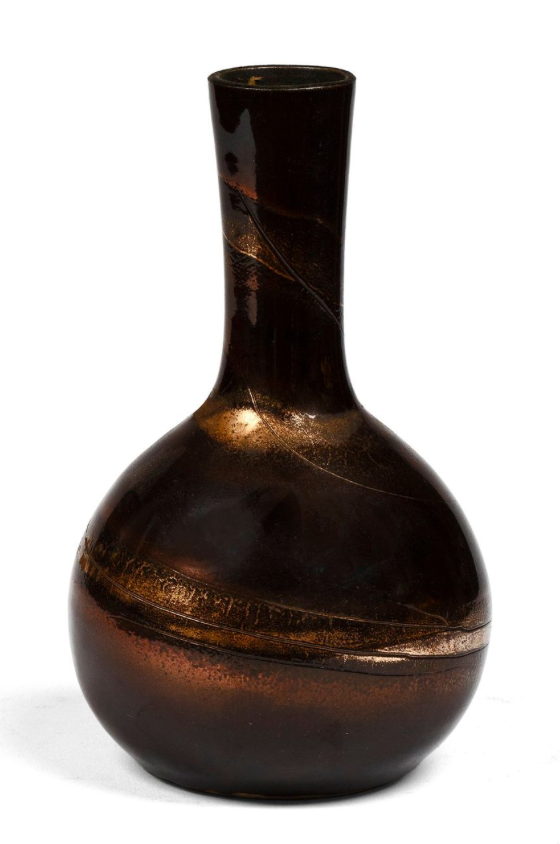
Jean Besnard Enameled Ceramic Soliflore Vase

$2,600.00

Call For Location | 203-325-8070

262984

Dimensions: 7 1/4 H X 4 1/4 D

A Jean Besnard Bottle Vase, Montparnasse PeriodCirca 1928–1935
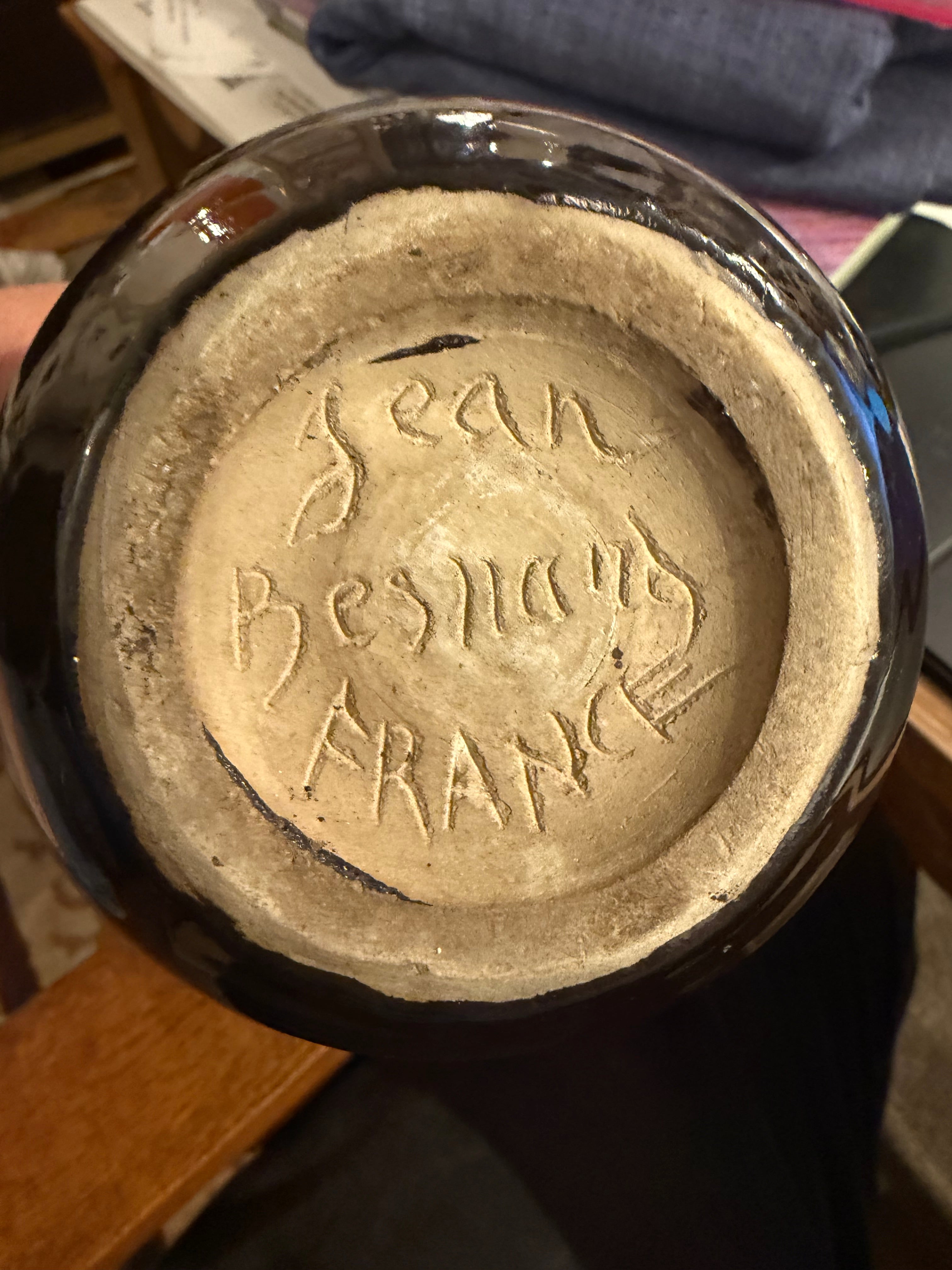
Signed to the underside in script incised into the clay body: Jean Besnard / FRANCE
A bottle-form vase with a low globular body and a tall cylindrical neck, the surface glazed in a deep brown-black ground over which metallic streaks of gold and copper lustre have been projected — broad ribbons sweeping diagonally across the shoulder and encircling the body, narrower wisps lifting through the neck. The lustre has been reduced and crackled by a second low-temperature firing, the metallic surface reading as variably matte and reflective against the dark ground. The interior of the neck and the unglazed foot show the buff stoneware body.
This is the technique that established Besnard's reputation in the late 1920s. Working with an assistant, he projected gold and platinum enamel from a compressor gun onto a previously fired dark base — most often glazed black, sometimes blue, beige, or pink — in spirals, wisps, ribbons, and bands. A second firing at low temperature, deliberately controlled to produce a crackled surface, reduced the metallic lustre and gave the glaze its characteristic depth. Period critics described the streaks as "encircling his vases like a whirlwind." The Ministry of Fine Arts acquired a black vase and bowl with platinum decoration from his showing at Galerie Reitlinger in 1929. He had already received a silver medal at the 1925 Exposition Internationale des Arts Décoratifs for related work — black-ground vessels with crackled gold ribbons, juxtaposing matte and brilliant finishes.
The signature is consistent with the convention Besnard used at his Montparnasse workshop at 5 rue Campagne Première, where he moved in early 1928: full name engraved in the soft clay before firing, with FRANCE below, sometimes dated. He worked there until 1939, in a building shared with the studios of François Pompon, Modigliani, Giacometti, Kandinsky, Miró, Max Ernst, and Foujita. Throwing was usually delegated to a qualified assistant working under his direct supervision, while incising, glazing, and decoration were his own work; his pieces were fired in a gas kiln at 950°C for twenty-four hours.

About Jean Besnard (1889–1958)
Son of the painter Paul-Albert Besnard (1849–1934) and the sculptor Charlotte Dubray (1854–1931), Jean Besnard trained first as a painter before turning to ceramics through contact with Paul Jacquet and, more decisively, Étienne Avenard — himself a pupil of André Metthey. He devoted himself to clay from around 1910, working initially at a studio in Ivry-Port under the auspices of the Compagnie Générale d'Électrocéramique, where he refined his glazes and his vocabulary of form.
His maturity dates from 1927 to 1928. At Ivry in 1927 he developed the metallic-streak decoration that would define his work — the technique seen on the present vase — and in early 1928 he moved to a new workshop at 5 rue Campagne Première in Montparnasse, where the gas kilns and spray-glazing equipment allowed him to produce at a different scale and consistency. He exhibited at the Salon des Tuileries (until 1931), the Salon des Artistes Décorateurs (where he held E.J. — exempt from jury — status), the Salon d'Automne, and at galleries including Le Grand Dépôt, La Crémaillère, Galerie Reitlinger, Galerie de l'Essor Décoratif Moderne, Daum, and René Drouet. In 1929 he was part of the French delegation at the International Exhibition of Montjuïc in Barcelona, shown alongside the Manufacture de Sèvres, Émile Decoeur, and Émile Lenoble, with some pieces installed in the pavilion designed by Wybo and decorated by Ruhlmann.
He is credited with the invention of crispé — a contorted white glaze with a shagreen-like crackle — and is known for engraving the clay body with a toothed wheel and for impressing textile patterns (lace, tulle) into the surface before firing. His work was published in René Chavance's La céramique et la verrerie (1929) and Marcel Valotaire's La céramique française moderne (Van Oest, 1930). He continued at Montparnasse until 1939.
Standard reference: Alain-René Hardy and Patrick Wilson, Jean Besnard: A Modern Potter / Potier Moderne, Éditions des Robaresses.

The Antiquarian at Greenwich

Jean Besnard Enameled Ceramic Soliflore Vase

$2,600.00

Call For Location | 203-325-8070

262984

Dimensions: 7 1/4 H X 4 1/4 D

A Jean Besnard Bottle Vase, Montparnasse PeriodCirca 1928–1935
Signed to the underside in script incised into the clay body: Jean Besnard / FRANCE
A bottle-form vase with a low globular body and a tall cylindrical neck, the surface glazed in a deep brown-black ground over which metallic streaks of gold and copper lustre have been projected — broad ribbons sweeping diagonally across the shoulder and encircling the body, narrower wisps lifting through the neck. The lustre has been reduced and crackled by a second low-temperature firing, the metallic surface reading as variably matte and reflective against the dark ground. The interior of the neck and the unglazed foot show the buff stoneware body.
This is the technique that established Besnard's reputation in the late 1920s. Working with an assistant, he projected gold and platinum enamel from a compressor gun onto a previously fired dark base — most often glazed black, sometimes blue, beige, or pink — in spirals, wisps, ribbons, and bands. A second firing at low temperature, deliberately controlled to produce a crackled surface, reduced the metallic lustre and gave the glaze its characteristic depth. Period critics described the streaks as "encircling his vases like a whirlwind." The Ministry of Fine Arts acquired a black vase and bowl with platinum decoration from his showing at Galerie Reitlinger in 1929. He had already received a silver medal at the 1925 Exposition Internationale des Arts Décoratifs for related work — black-ground vessels with crackled gold ribbons, juxtaposing matte and brilliant finishes.
The signature is consistent with the convention Besnard used at his Montparnasse workshop at 5 rue Campagne Première, where he moved in early 1928: full name engraved in the soft clay before firing, with FRANCE below, sometimes dated. He worked there until 1939, in a building shared with the studios of François Pompon, Modigliani, Giacometti, Kandinsky, Miró, Max Ernst, and Foujita. Throwing was usually delegated to a qualified assistant working under his direct supervision, while incising, glazing, and decoration were his own work; his pieces were fired in a gas kiln at 950°C for twenty-four hours.

About Jean Besnard (1889–1958)
Son of the painter Paul-Albert Besnard (1849–1934) and the sculptor Charlotte Dubray (1854–1931), Jean Besnard trained first as a painter before turning to ceramics through contact with Paul Jacquet and, more decisively, Étienne Avenard — himself a pupil of André Metthey. He devoted himself to clay from around 1910, working initially at a studio in Ivry-Port under the auspices of the Compagnie Générale d'Électrocéramique, where he refined his glazes and his vocabulary of form.
His maturity dates from 1927 to 1928. At Ivry in 1927 he developed the metallic-streak decoration that would define his work — the technique seen on the present vase — and in early 1928 he moved to a new workshop at 5 rue Campagne Première in Montparnasse, where the gas kilns and spray-glazing equipment allowed him to produce at a different scale and consistency. He exhibited at the Salon des Tuileries (until 1931), the Salon des Artistes Décorateurs (where he held E.J. — exempt from jury — status), the Salon d'Automne, and at galleries including Le Grand Dépôt, La Crémaillère, Galerie Reitlinger, Galerie de l'Essor Décoratif Moderne, Daum, and René Drouet. In 1929 he was part of the French delegation at the International Exhibition of Montjuïc in Barcelona, shown alongside the Manufacture de Sèvres, Émile Decoeur, and Émile Lenoble, with some pieces installed in the pavilion designed by Wybo and decorated by Ruhlmann.
He is credited with the invention of crispé — a contorted white glaze with a shagreen-like crackle — and is known for engraving the clay body with a toothed wheel and for impressing textile patterns (lace, tulle) into the surface before firing. His work was published in René Chavance's La céramique et la verrerie (1929) and Marcel Valotaire's La céramique française moderne (Van Oest, 1930). He continued at Montparnasse until 1939.
Standard reference: Alain-René Hardy and Patrick Wilson, Jean Besnard: A Modern Potter / Potier Moderne, Éditions des Robaresses.

Join our Mailing List

Sign up to receive updates on what's happening at Avery & Dash

My Cart

Subtotal: $0.00

Your cart is currently empty.